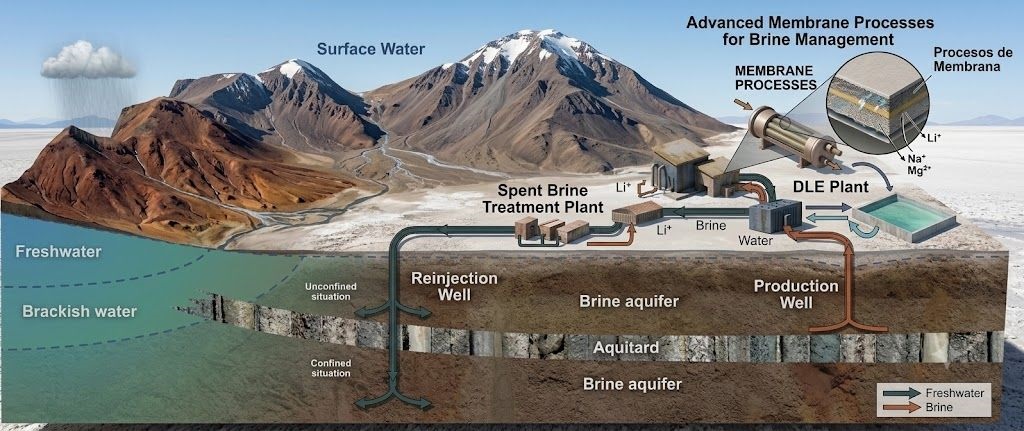

The BMBF250004 project, developed under the ANID–BMBF Chile–Germany joint call, aims to contribute to the more sustainable implementation of Direct Lithium Extraction (DLE) technologies in Chilean salars.


The initiative is led by the University of Chile, through the Advanced Mining Technology Center (AMTC) and the Andean Geothermal Center of Excellence (CEGA), together with the Karlsruhe Institute of Technology (KIT) in Germany.

The project combines technological development, scientific research, and community engagement to address some of the main challenges associated with the future implementation of DLE technologies: efficient water use, the management and potential reinjection of depleted brines, and community understanding and engagement regarding these emerging technologies

Main Lines of Work
Lithium Recovery and Efficient Water Management

Development of an intensified membrane-based process to recover lithium while simultaneously obtaining high-quality water from brines. This line of work focuses particularly on advancing toward production processes that make more efficient use of water resources.

2. Assessment of Brine Reinjection

Development of geological, hydrogeological, and hydrogeochemical models to assess the reinjection of depleted brines into deep salar aquifers and better understand its potential impacts.

3. Community Engagement and Dialogue

Development of engagement and participation activities aimed at strengthening knowledge and understanding of DLE technologies and their environmental and territorial implications. The goal is to contribute to an informed and responsible technological transition.

Across these three lines of work, the project also seeks to strengthen scientific cooperation between Chile and Germany, support the training of graduate students and early-career researchers, and generate scientific knowledge that contributes to the sustainable development of Chile’s lithium industry.

Development of geological, hydrogeological, and hydrogeochemical models to assess the reinjection of depleted brines into deep salar aquifers and better understand its potential impacts.

Development of engagement and participation activities aimed at strengthening knowledge and understanding of DLE technologies and their environmental and territorial implications. The goal is to contribute to an informed and responsible technological transition.

Across these three lines of work, the project also seeks to strengthen scientific cooperation between Chile and Germany, support the training of graduate students and early-career researchers, and generate scientific knowledge that contributes to the sustainable development of Chile’s lithium industry.

Project Team

Director
WhatsApp Image 2026-05-15 at 10.48.55

Humberto Estay

Researcher (AMTC)

Imagen3

Fabian Nitschke

Researcher (KIT)
Diego_Morata_CEGA

Diego Morata

Researcher (CEGA)
Investigadores
linda-danieleok.jpg

Linda Daniele

Investigadora CEGA
1704495631362

Matías Taucare

Investigador CEGA
Imagen6

Santiago Maza

Investigador CEGA
placeholder-7.png

Santiago Montserrat

Investigador Asociado AMTC

WhatsApp Image 2026-05-15 at 10.50.16

Bárbara Bravo

Investigadora CEGA
placeholder-7.png

Miguel Lemus

Investigación AMTC
WhatsApp Image 2026-05-15 at 10.48.43

Michelle Quilaqueo

Investigadora AMTC

WhatsApp Image 2026-05-15 at 10.49.11

Lucy Muruchi

Investigadora post-doctoral AMTC
placeholder-7.png

Marcos Maccioli

Investigador post-doctoral CEGA
Imagen11

Diego Aravena

Investigador doctoral CEGA